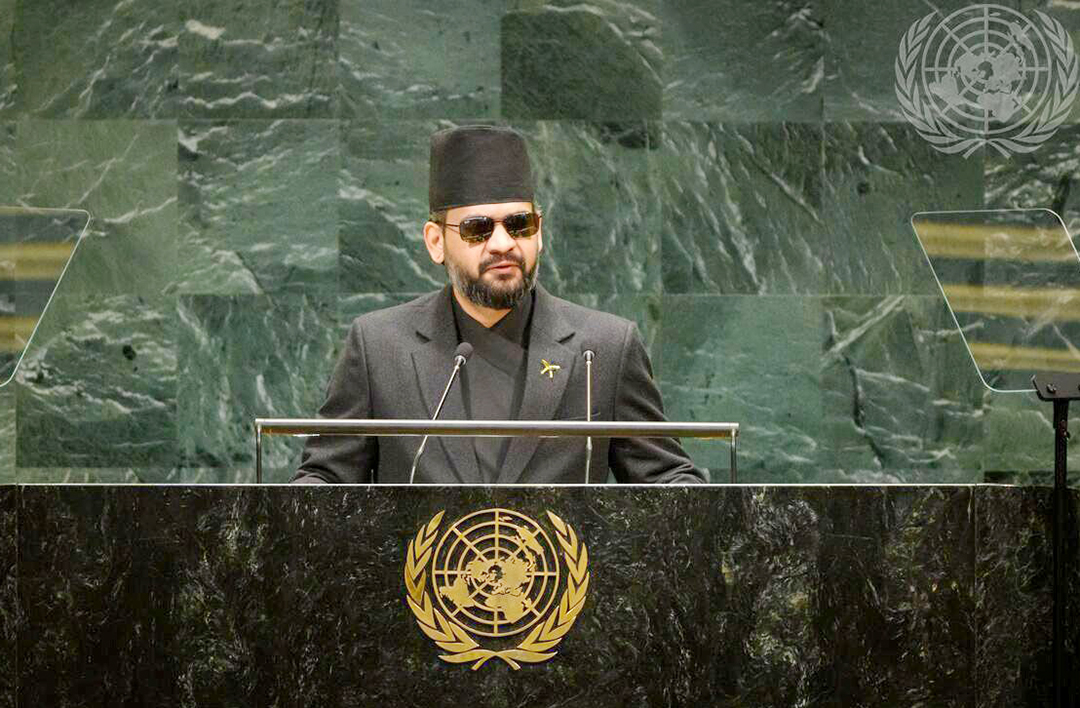
Kathmandu, Sept. 26: Prime Minister Balendra Shah said at the United Nations General Assembly that those who have contributed more to the problems created by climate change, and those with greater capacity to respond, must do more.
Speaking at the Assembly ongoing at New York, on Friday morning, he said, “Climate justice cannot just remain a beautiful phrase in a United Nations Document. People of our country be allowed to build their future instead of constantly rebuilding their past.”
Stating that Nepal was not at the UN to blame any country or continent, or to turn climate change into another geopolitical battlefield, he asked one and all to recommit to shared responsibility and solidarity.
PM Shah said that climate justice is not only about money but also about distributive justice – who bears the costs, and procedural justice – who has a voice.
It is about whether the future of mountain communities, small island states, landlocked and least-developed countries, and generations yet unborn count equally. “Starting tomorrow at the ‘Sagarmatha to the Sea’ side-event right here at the United Nations, Nepal is ready to help lead this conversation,” he said.
PM Shah has reminded the UNGA that through the United Nations Framework Convention on Climate Change, the international community has already agreed to the principle of common but differentiated responsibilities and respective capabilities.
He sought the international solidarity and support in the post-disaster rebuilding. “Nepal now faces a massive task of recovery and reconstruction. After at least 1,400 confirmed deaths and over 6,000 people still missing, our rapid assessments peg physical recovery needs at about 10 per cent of GDP,” he said.
He further added, “We did not create this crisis. Yet we are paying a colossal price for it. Our glaciers are retreating. Our mountain slopes are becoming unstable. Our rivers are becoming less predictable. And every major disaster threatens to erase years of development.”
For Nepal – a country that contributed less than 0.1 per cent of the global greenhouse-gas emissions, climate catastrophe is not just a humanitarian event, but a development emergency.
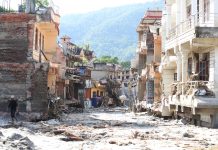
“The disaster destroyed roads, bridges, schools, homes, farms and livelihoods. It destroyed clean energy infrastructure that we need to fuel our future. And it forces a poor country to borrow money to repair damage it did not cause,” said Prime Minister Shah.
According to him, the international system is under now and, many often, military and economic power determines whose voice is heard. In such a scenario, Nepal believed it needs a much fairer global economic order. “The weak would not simply have to accept whether the powerful decide,” he said.
Referring to the devastating Bhotekoshi floods, termed as ‘Himalayan Tsunami’, he lamented that he couldn’t simply speak about development, democracy, peace and the hopes of a young nation, instead, he was forced speak about death and destruction of epic proportions.
“It was not just a local tragedy, it was a warning to the world. And I ask you today: have we really heard that warning?” asked the prime minister while recalling the visit of UN Secretary-General Antonio Guterres to Nepal when the latter warned humanity about the madness of an impending climate disaster.
“That cry from the rooftop of the world was not heard loudly enough. We in Nepal heard it. Our communities heard it. Scientists around the world heard it. They repeated it with evidence. But we, the political leaders of the world, have been negligent to translate those warnings into action at the speed and scale that vulnerable people require,” he said. “Last month, we saw the tragic consequences.”
According to him, this tells us something fundamental – Climate change does not recognize borders. Glaciers and floods do not travel with a visa stamped on passports.
Stating that the Himalayas are not peripheral to the planet but the part of the planet’s life-support system, PM Shah proposed establishing a Himalayan Climate Resilience Mechanism, led by Nepal, India and China.
He said that this mechanism will help in sharing satellite data and expertise, monitor dangerous glacial lakes, let us strengthen joint early-warning systems.
He said, “When disaster strikes, let us coordinate assistance across borders. Let the Himalayas become a laboratory of international cooperation, rather than a frontier of fragmented information.”
When a climate-driven disaster destroys the infrastructure of a poor country, the answer cannot simply be another mega loan or a patchwork of small grants, maintained the prime minister.
He stressed that Nepal needs adequate grant-based support from the world. The Loss and Damage Fund, the Global Environment Facility and other relevant financing mechanisms remain grossly inadequate.
“Climate finance must not become a bureaucratic maze through which vulnerable countries spend years proving that they need help. When the house is burning, we do not ask the family to complete fifty forms. We act,” he said. “That is what climate justice must mean.” TRN