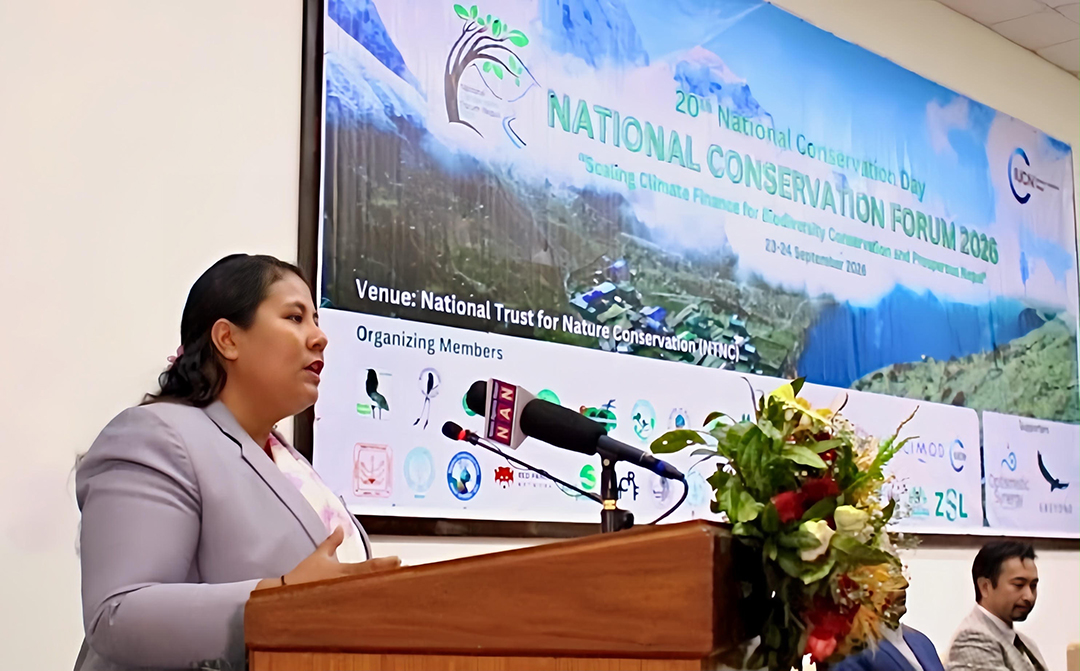
Kathmandu, Sept. 25: Minister for Agriculture, Forest and Environment Gita Chaudhary has said indigenous peoples, native communities and Dalits are bearing the direct impacts of climate change and disasters, with persons with disabilities facing even greater challenges.
Addressing the 3rd Asia-Pacific Regional Conference on Indigenous Women and Girls with Disabilities, organised by the National Indigenous Disabled Women Association Nepal (NIDWAN), Minister Chaudhary said concerns of communities affected by climate change and disasters must be prioritised in the formulation of government policies.
Stressing the need to address the rights and concerns of indigenous women and girls with disabilities through intersectional approach, she said they face discrimination linked to indigenous identity, gender and disability.
“Indigenous women with disabilities must have their rights ensured. Inclusive climate justice and disaster management are the needs of the hour,” the Minister said.
She added that her ministry was taking necessary initiatives to ensure the rights of indigenous women and adolescent girls with disabilities.
She stressed the need for state agencies to work with greater sensitivity towards the rights and concerns of indigenous peoples, Dalits and persons with disabilities.
Minister Chaudhary said the contribution made by indigenous leaders in the past to bring their issues and voices from the streets to Parliament was particularly noteworthy.
Referring to the important role played by indigenous peoples in various movements, she stressed that the concerns of the community should not be forgotten.
Referring to the Constitution of Nepal’s provisions guaranteeing equality, social justice and the rights of persons with disabilities, Minister Chaudhary said it was everyone’s responsibility to ensure that these constitutional rights were implemented in practice.
Speaking at the event, National Assembly member Suresh Ale Magar said indigenous people’s knowledge and traditional practices should be recognised and incorporated into efforts to address climate change its consequences.
He said the indigenous communities, who have historically lived in close harmony with nature, possess valuable knowledge and practice that could continue to addressing climate-related challenges.
Shova Sunar, chairperson of National Indigenous Women’s Federation, called for the urgent need for climate justice, citing that while indigenous communities suffer the most from natural disasters like floods, their voices remain ignored in the state policy and international forums.
She also asked the activists of the pacific for their collective solidarity to exert pressure to the world leaders, including those at the United Nations, to protect the ancestral knowledge and physical safety of vulnerable groups amidst a changing global landscape.
Chairperson of NIDWAN, Dr. Pratima Gurung, said the gathering is being convened in Nepal to strengthen collective voices, deepen regional solidarity and advance meaningful participation and representation in regional and global processes.
Speaking about the rights and representation of indigenous peoples in the region, Gurung said indigenous women continue to receive limited attention both within indigenous movements and the broader women’s movement.
It is estimated that 28 million indigenous women and girls with disabilities live globally. It is also estimated that 45 million indigenous persons with disabilities live in developing and underdeveloped countries of Asia pacific.