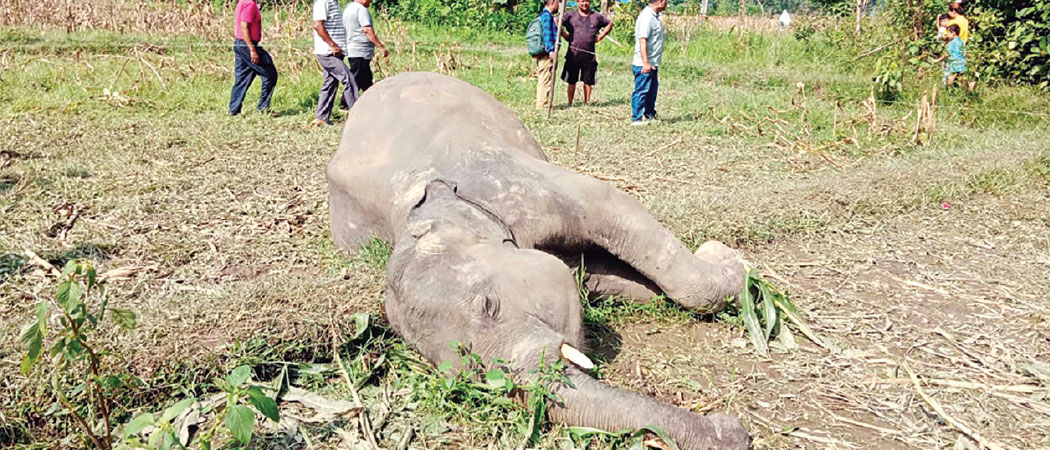
Kathmandu, Sept. 15: The growing overlap between human settlements and elephant habitats in eastern Nepal has placed both people and wild elephants at increasing risk, with 97 people killed in elephant attacks and 45 elephants dying from various causes over the past two decades.
According to Birendra Gautam, Chief of the Koshi Conservation Centre of the National Trust for Nature Conservation (NTNC), 45 wild elephants have died in Koshi Province since fiscal year 2005/06. Jhapa recorded the highest number of elephant deaths, with 25.
Six elephants died in and around the Koshi Tappu Wildlife Reserve, including four from electrocution and two from gunshot wounds. Two elephants were shot dead in Udayapur and two died from electrocution in Saptari.
Morang recorded eight elephant deaths. One was killed by gunfire and another was electrocuted, while the causes of death of the remaining six were not established. Two elephants died from electrocution in Sunsari.
The figures indicate that Jhapa is the province’s most vulnerable district in terms of both elephant deaths and human-elephant conflict.
The NTNC said the conflict has intensified as settlements and farmland have expanded into traditional elephant movement routes. The increasing use of electricity in farmland, unsafe electrical infrastructure and growing human activity have further heightened the risks. Since fiscal year 2023/24 alone, 12 wild elephants have died in Koshi Province.
“Protecting elephant habitats and their traditional movement routes while reducing electrical risks in settlements remains a major challenge,” Gautam said.
97 people die in elephant attacks
NTNC records show that 97 people were killed by elephants in Koshi Province between fiscal years 2005/06 and 2022/23, with Jhapa suffering the heaviest human losses.
Jhapa recorded 40 deaths between 2005/06 and 2018/19. A further 32 people were killed between 2019/20 and 2022/23, taking the district’s total to 72.
Morang recorded 17 deaths, while Sunsari and Ilam recorded three each and Udayapur two.
Behind these figures are families that have lost breadwinners, homes and livelihoods. For communities living close to elephant habitats, venturing into fields, protecting crops or returning home after dark can carry an element of danger.